How Creatvise Thirdeye Is Empowering Referencing in Design
Every creation begins with a reference. It could be a photograph, product, material, building, typeface, interface, piece of nature, mechanical structure, or simply an unexpected visual discovered somewhere on the web. Before designers create, they observe, collect, compare, interpret, connect, and translate existing knowledge into new possibilities.
Yet referencing, one of the most fundamental stages of the design process, remains largely underserved by modern creative tools. We have increasingly powerful tools for creating, editing, rendering, and generating, but the process that happens before creation finding the right references, understanding them, connecting them, and developing a visual direction is still scattered across searches, screenshots, downloads, folders, browser tabs, and moodboards.
At Creatvise, we believe referencing should not be treated as a secondary task. Referencing is part of how designers think. Creatvise Thirdeye is built to empower that process by making visual research faster, more connected, and more multidisciplinary.
Referencing Is More Than Finding Inspiration
A reference is not simply an image a designer likes. It carries information about form, composition, material, colour, interaction, typography, construction, culture, function, behaviour, movement, and context. Designers use this information to understand what already exists, recognize patterns, challenge assumptions, and establish a foundation from which something new can emerge.
A product designer may study architecture to understand structure and proportion. An architect may explore automotive surfaces for form and materiality. A UI/UX designer may reference editorial design to understand hierarchy. A fashion designer may study nature for patterns, textures, and structures. An industrial designer may simultaneously explore mechanical systems, biology, manufacturing, and science fiction.
The real value therefore does not exist only within an individual reference. It emerges from the relationships designers create between multiple references. This is where referencing becomes a form of creative intelligence—the ability to observe existing ideas, understand their context, and connect seemingly unrelated information into a new creative direction.
The Problem Is Not Access to Inspiration, but Navigating It
We have access to more visual information than at any point in history. Designers can explore millions of images, projects, products, interfaces, environments, and ideas within seconds. The challenge is no longer whether inspiration exists. The challenge is finding what is relevant and preserving the thinking around it.
A typical visual research process can involve moving between Google Images, Pinterest, Behance, Linkedin, Instagram, design publications, portfolios, brand websites, digital archives, blogs, marketplaces, and dozens of browser tabs within a single session. A designer searches, scrolls, opens an image, downloads it, creates a folder, moves the file, returns to the browser, searches again, and repeats the same process.
When a project requires 50, 100, or hundreds of references to properly understand a direction, visual research quickly turns into manual information management. The designer is no longer only thinking about the design problem, they are managing the process around thinking. These repeated interruptions create cognitive load and gradually break the creative momentum that research is supposed to enable.
From One Reference to Hunderds of Connected Real-time Visuals
Designers do not always know how to describe what they are looking for. Sometimes a particular form, visual language, composition, texture, material, lighting style, or aesthetic is immediately recognizable visually but difficult to translate into the right combination of keywords.
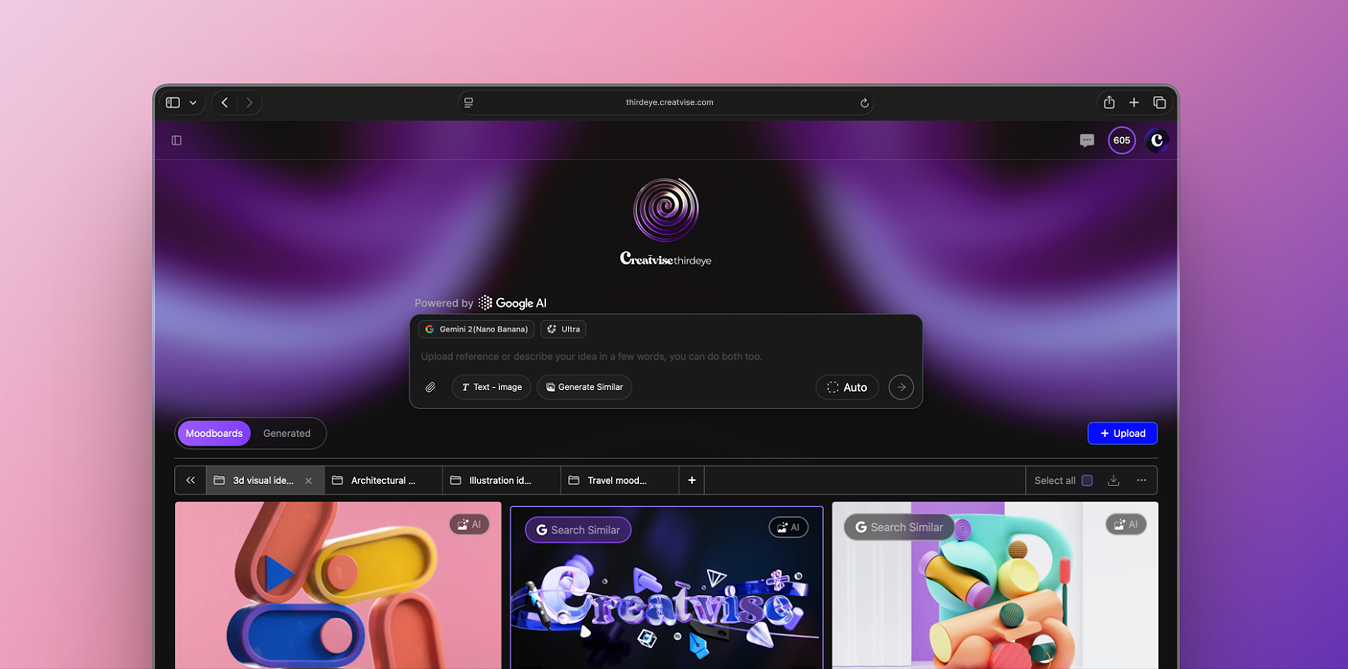
Creatvise Thirdeye approaches this problem visually. A creator can begin with a single reference image and use Search Similar to discover 45+ visually related references across the web within seconds. Instead of repeatedly translating visual thinking into text-based searches, the reference itself becomes the starting point for exploration.
This changes the relationship between search and creative research. One useful reference can open multiple visual directions, and those directions can lead to entirely different ideas. Rather than spending significant time manually repeating searches across platforms, designers can use that time to evaluate what they discover, understand why certain references matter, and decide which connections are worth developing.
From Searching References to Curating Creative Direction
Finding images faster is only one part of the problem. The real creative value begins after discovery, when references are compared, grouped, rejected, reorganized, and connected. Individual images gradually begin forming patterns, and those patterns begin defining a creative direction.
This is why Creatvise Thirdeye connects visual discovery with reference collection, projects, folders, and moodboarding within the same workflow. Instead of discovering something on one platform, downloading it to another location, and rebuilding the research inside another application, references can remain within a connected visual workspace from discovery through curation.
Extending Visual Research Across the Web
Creative research does not happen inside one platform. An important reference might appear while reading an article, exploring a portfolio, browsing Pinterest, studying a product, researching an architecture project, or simply navigating an unfamiliar corner of the web. A visual research workflow therefore needs to extend beyond the boundaries of a single application.
The Creatvise Thirdeye Browser Extension brings this research workflow directly into the browser. Creators can capture visual references from websites through the floating One-Click Save button or the right-click menu and continue exploring without repeatedly leaving the page or manually downloading files.
Saved visuals remain connected with the Creatvise Thirdeye dashboard, where they can be organized into projects and folders, curated into moodboards, and developed into broader visual directions. The browser becomes an extension of the research environment, while Thirdeye becomes the connected workspace behind it. This creates a continuous flow from discovering a reference to capturing, organizing, comparing, and eventually translating it into creative direction.
Multidisciplinary Referencing Can Create Stronger Ideas
Some of the most interesting ideas in design emerge when knowledge moves between disciplines. The visual language of a futuristic vehicle may be influenced by aerospace engineering, fashion, architecture, gaming, and biology. A digital interface may borrow principles from editorial design. A building façade may inspire a graphic identity, while textile structures can influence industrial surfaces and mechanical systems can become references for motion design.
This is why we believe referencing should move beyond isolated design categories. A reference should matter because of what the designer sees in it, not because of the discipline or category in which it was originally created.
Creatvise Thirdeye is built around this multidisciplinary approach to visual research. Rather than keeping graphic designers inside graphic design, architects inside architecture, or product designers inside industrial design, the goal is to help creators explore across disciplines and discover relationships that might otherwise remain invisible.
This ability to move between different creative domains is becoming increasingly important as the boundaries between media, product, spatial, digital, and engineering design continue to converge.
AI Should Expand Exploration, Not Replace Creative Thinking
Generative AI has dramatically accelerated the production of visual outputs, but faster generation does not automatically create stronger ideas. Without research, context, and creative direction, generation can quickly become repetitive and disconnected from the problem a designer is actually trying to solve.
We believe AI has another important role in the design process: expanding the space available for exploration. AI can help designers navigate larger collections of visual information, discover related references faster, explore variations, and reduce repetitive work surrounding creative research.
However, deciding why a reference matters remains fundamentally human. The designer determines what is relevant, identifies the connection, rejects what does not belong, interprets context, and ultimately translates those references into an original direction. AI should therefore increase the designer's capacity to explore rather than replace the designer's responsibility to think.
Building a Visual Research Layer for the Design Process
Our ambition with Creatvise Thirdeye goes beyond building another inspiration board or image collection tool. We see referencing as an important intelligence layer at the beginning of the design production lifecycle (Pre-Production) a space where visual information can be discovered, collected, organized, understood, and connected before it becomes creative direction.
Today, Thirdeye enables creators to move from a single reference toward broader visual discovery, organized collections, and moodboarding. The browser extension extends that capability across the web, allowing inspiration discovered naturally during browsing to remain connected with the same research environment.
Over time, we believe this visual research layer can become increasingly connected with creation itself. Inspiration and production should not exist as completely separate workflows. Research informs direction, direction informs creation, and creation continuously produces new references and possibilities. Connecting those stages is central to the broader vision of Creatvise: an AI-driven multidisciplinary design platform connecting the design production lifecycle from inspiration to creation in one unified workflow.
Empowering Referencing Means Empowering Better Design Thinking
The future of design will not be defined only by how quickly we can generate something. It will also be defined by how deeply we can explore before deciding what deserves to be created.
Designers will increasingly work across disciplines, navigate larger visual knowledge spaces, and use AI to accelerate exploration. The opportunity is to remove the repetitive work surrounding that process so creators can spend less time managing references and more time understanding the relationships between them.
That is what we mean by empowering referencing in design. Creatvise Thirdeye is not designed to tell creators what to make. It is designed to give them a faster, broader, and more connected space to explore what could be made.
Because before something original is created, someone has to observe what already exists, interpret it differently, and see a connection that others did not.
Very often, that begins with a reference.